

 Trending
  VISIT THIS SITE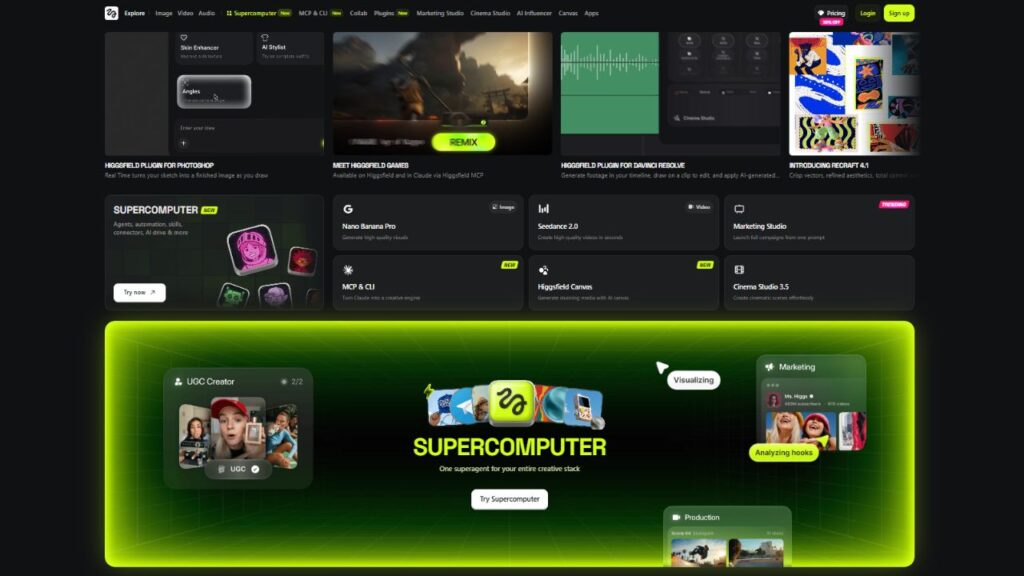
 ChatGPT
 Perplexity
 Claude AI

 Official Website
 Higgsfield AI Review: Is It Worth It in 2026?
I have lost track of how many AI video tools I have opened, poked at for ten minutes, and closed in mild disappointment. Most of them generate a clip, sure, but the second you ask for a specific camera move — a crash zoom, a dolly-in, anything a real director would ask for — you are back to typing increasingly desperate prompts and hoping the model understands “cinematic.” Higgsfield was the first one that actually understood what a crash zoom is, and that single difference changed how I think about AI video.
This review covers what Higgsfield AI actually does, what it costs in 2026, where it beats the competition, and where it still falls short.
Quick Facts
- Developer/Company: Higgsfield AI
- Category: AI video and image generation platform
- Free Plan: Yes (limited, watermarked)
- Starting Price: $15/month (Starter plan)
- Best For: Filmmakers, social video creators, marketers, UGC and ad producers
- Platforms: Web (no native mobile app at the time of writing)
- gyanshout.com Rating: 4.2/5
What Is Higgsfield? (And Who Actually Needs It)
Higgsfield is not really one AI model. It is a creative hub that sits on top of more than a dozen video and image models — Kling, Sora 2, Google Veo 3.1, Seedance, WAN, and Nano Banana Pro among them — and wraps them in director-style controls so you are not just typing prompts into a black box.
The pitch is simple: instead of guessing what words make an AI model produce a crane shot, you tell Cinema Studio directly. Pick the lens, set the camera path, choose the motion preset, and the system translates that into whichever underlying model handles it best.
Who actually needs this? Anyone making short-form video for a living or a side hustle. Music video directors, UGC creators running ad campaigns, social media managers who need five Reels by Friday, and indie filmmakers storyboarding scenes before a real shoot all show up in Higgsfield’s user base for a reason. If you only need the occasional meme clip, this is overkill. If video output is part of your job, it earns its place.
Key Features of Higgsfield — What Makes It Stand Out
Cinema Studio and Camera Controls
This is the feature that put Higgsfield on the map. Instead of hoping a text prompt produces the right motion, you select crash zooms, dolly shots, crane moves, and Dutch angles from an actual interface. Independent reviewers consistently point out that these virtual camera controls function as genuine directorial tools rather than dressed-up presets. For anyone who has tried to prompt-engineer a “slow push-in” out of a generic text-to-video model, the difference is night and day.
Soul ID (Character Consistency)
Keeping the same character’s face, hair, and proportions consistent across multiple shots is one of the hardest unsolved problems in AI video. Soul ID is Higgsfield’s answer, and it is widely regarded as the platform’s standout feature. No other consumer-facing tool currently matches its ability to hold a character’s identity steady across different shots, models, and creative scenarios. If you are building a virtual influencer, a recurring ad character, or an episodic content series, this single feature can save hours of frustrated re-rolling.
Multi-Model Access
Rather than locking you into one engine, Higgsfield routes your request across more than fifteen models depending on what you need, including Sora 2, Veo 3.1, Kling 3.0, WAN 2.6, Seedance 2.0, and Hailuo 02, all sitting under one subscription. Want Sora’s long-form coherence for one shot and Kling’s speed for another? You do not need three separate subscriptions to get there.
Soul Jump (Performance Transfer)
Soul Jump lets you feed in a reference video of movement or expression and map that performance onto your own character. Think motion capture without the suit: your character moves the way the reference clip moves, while Soul ID keeps the face and identity locked in place across the transfer.
Lipsync Studio
Dialogue-heavy content is brutal for most AI video tools — lips drift out of sync within a few seconds. Lipsync Studio is a dedicated workflow built specifically to keep mouth movement matched to audio, which matters a lot if you are producing talking-head UGC ads or narrated explainer clips.
Sora 2 Enhancer and Upscale
Raw model output often looks slightly off — flat color, soft motion, low resolution. The Enhancer pass and Upscale tool exist to take a clip from “technically impressive” to “actually publishable,” normalizing tone and motion before you push it to a feed where shaky AI artifacts get noticed fast.
Image Tools: Relight, Face Swap, Angles, AI Stylist
Higgsfield is not only video. Its image side covers relighting a shot, swapping faces, generating new camera angles of an existing image, and applying stylist presets. Combined with image models like Nano Banana Pro at 4K resolution, this image layer is strong enough to function as a standalone tool for some creators.
Marketing Studio and Click-to-Ad Pipeline
Built specifically for performance marketers, this turns a product photo or basic brief into an ad-ready video sequence, aimed squarely at the TikTok and Reels ad workflow rather than narrative filmmaking.
Higgsfield Pricing Plans — What You Actually Get for Your Money
Higgsfield uses a credit-based subscription system, and the credit cost per generation depends heavily on which model you pick. A Kling clip might cost 15 to 25 credits, while a Sora 2 or Veo 3.1 generation runs 40 to 70 credits, with images ranging from roughly 0.25 to 5 credits depending on the model. That distinction matters more than the sticker price, because two people on the same plan can have very different experiences depending on which models they actually use.
As of the most recent pricing data pulled directly from Higgsfield’s official pricing page, the structure looks like this:
| Plan | Monthly Price | Annual Price | Credits/Month | What You Get |
|---|---|---|---|---|
| Free | $0 | — | Limited daily credits | Watermarked output, single concurrent job |
| Starter | $15 | — | 200 | Selected models only, Veo 3 family blocked |
| Plus | $49 | $39/mo | 1,000 | All models unlocked, some unlimited image models |
| Ultra | $129 | $99/mo | 3,000 | Unlimited video model included, priority access |
| Business | $89/seat | $62/seat | Scales with seats | Team management, shared assets |
A few things worth flagging plainly. Plus and Ultra advertise “unlimited” generation on select models, but the official pricing page itself carries a disclaimer that unlimited usage can face dynamic speed adjustments during high-traffic periods — in other words, “unlimited” can mean slower, not infinite. Annual billing also does not give a flat discount across every tier; the savings reportedly range from 0 to 30 percent depending on plan, not the flat percentage the marketing badge implies.
For most individual creators, Plus is the realistic entry point if you want access to premium models like Sora 2 and Veo 3.1 without constantly hitting a wall. Starter is fine for testing the waters but locks you out of the flagship models that make Higgsfield worth talking about. Ultra only makes sense if you are producing in volume — agencies, daily content shops, or anyone running multiple campaigns at once.
Have you tested the Starter plan before committing to something higher? What did you actually manage to produce with 200 credits?
Pros and Cons of Higgsfield
Pros:
- Cinema Studio gives genuine directorial control over camera movement, not just prompt suggestions
- Soul ID delivers the strongest character consistency currently available in a consumer-facing tool
- Access to 15+ top-tier models (Sora 2, Veo 3.1, Kling 3.0, Seedance) under one subscription and one credit pool
- Lipsync Studio meaningfully improves dialogue-driven content over generic text-to-video output
- MCP and CLI support give developers a way to plug Higgsfield into agent workflows, which is unusual for this category
Cons:
- Credit transparency in the interface is weak; one reviewer expected to spend roughly 100 credits on a task and ended up spending close to 300 because of intermediary generations
- The free plan limits you to one concurrent job, which makes real evaluation slow and frustrating
- Premium models (Sora 2, Veo 3.1) are gated behind higher tiers, so the cheap plan is mostly a teaser
- “Unlimited” generation on Plus and Ultra can slow down during high-traffic periods, despite the label
- No native mobile app, so editing and reviewing output happens entirely in the browser
Which feature would actually move the needle for your workflow — Soul ID, Cinema Studio, or the multi-model access? Drop a comment if you have tried more than one.
How Does Higgsfield Compare to Alternatives?
| Tool | Best For | Starting Price | Free Plan | Overall Rating |
|---|---|---|---|---|
| Higgsfield | Cinematic camera control + character consistency | $15/mo | Yes (watermarked) | 4.2/5 |
| Runway | Comprehensive editing suite + Gen-4.5 model | $12/mo (annual) | Yes (125 one-time credits) | 4.0/5 |
| Kling AI | Budget-friendly photorealistic video | ~$10/mo | Limited | 3.9/5 |
| Pika Labs | Fast, lightweight social clips | ~$8/mo | Limited | 3.7/5 |
Runway pulls ahead on editing depth — tools like Aleph and Act-Two are not something Higgsfield offers natively. But Higgsfield’s advantage is that you are not locked into one model family; you get Runway-adjacent quality alongside Sora 2 and Veo 3.1 access without separate subscriptions for each. Kling and Pika are cheaper standalone options, but using them through Higgsfield’s wrapper gets you Soul ID and Cinema Studio controls that neither offers on its own.
Real-World Use Cases — Who Gets the Most Value?
The UGC ad creator. Sarah runs ad creative for three e-commerce clients. She uses Marketing Studio’s Click-to-Ad pipeline to turn product photos into short ad sequences, then runs the voiceover through Lipsync Studio so the talking-head segments do not drift out of sync. Soul ID keeps her recurring “brand face” consistent across every client’s campaign.
The indie filmmaker. Marcus is storyboarding a short film before booking a real crew. He uses Cinema Studio to block out crane shots and dolly moves on AI-generated stand-ins, which lets him show his cinematographer exactly what he wants before a single dollar is spent on equipment rental.
The social media manager. A small agency needs five to seven short-form clips a week for client TikTok accounts. The Plus plan’s credit pool covers steady weekly output across Kling and Nano Banana Pro, with Sora 2 reserved for the occasional hero piece that needs better narrative coherence.
The virtual character builder. A content creator running a fictional AI persona across YouTube Shorts and Instagram Reels relies almost entirely on Soul ID to keep that character’s face and proportions identical from video to video, something that breaks immersion fast if it drifts even slightly.
The student or hobbyist. Someone experimenting with AI filmmaking for a portfolio piece sticks to the free tier or Starter plan, accepting watermarks and model limits in exchange for learning the camera-control interface before committing real money.
Have you tried Higgsfield for any of these use cases? What was your actual experience with credit consumption?
My Honest Verdict — Should You Use Higgsfield?
Higgsfield earns its reputation in the two areas that matter most for cinematic AI video: camera control and character consistency. Cinema Studio genuinely behaves like a director’s toolkit rather than a glorified prompt box, and Soul ID solves a problem that prompt engineering alone has never solved well.
That said, the pricing structure rewards careful planning more than impulse subscribing. The Starter plan looks affordable until you realize it locks out the exact models that make Higgsfield worth using in the first place, and credit consumption inside the interface is not always predictable.
Score: 4.2/5
Use it if you are a content creator, marketer, or small studio that needs cinematic camera control and consistent characters across a real production pipeline. Skip it, or at least wait, if you need fully transparent, predictable pricing before you commit, or if your needs are occasional enough that a free tool would do just as well.
Try the free plan first, push a few generations through Cinema Studio, and see whether the camera controls actually change how you work before upgrading to Plus.
Higgsfield FAQ
Q : Is Higgsfield free?
Ans : Yes, there is a free plan, but it comes with watermarked output, a single concurrent job, and limited daily credits. It is enough to test the interface, not enough for serious production work.
Q : Is Higgsfield safe to use?
Ans : Payment processing runs through Stripe, and Higgsfield does not store full card details on its own systems. As with any cloud AI platform, treat generated content and prompts as non-private unless the platform states otherwise.
Q : What is Higgsfield best for?
Ans : Cinematic camera control, character consistency through Soul ID, and aggregating multiple top-tier video models (Sora 2, Veo 3.1, Kling 3.0) under a single subscription and credit pool.
Q : Higgsfield vs Runway — which is better?
Ans : Runway wins on editing depth with tools like Aleph and Act-Two. Higgsfield wins on multi-model flexibility and character consistency. If editing power matters most, pick Runway. If camera control and consistent characters matter most, pick Higgsfield.
Q : Does Higgsfield have a mobile app?
Ans : No native mobile app exists at the time of writing. Everything runs through the browser.
Q : Do unused Higgsfield credits roll over?
Ans : Credits are tied to your active subscription period and generally expire rather than rolling over indefinitely, so unused credits at the end of a cycle are typically lost.
Q : Can I get a refund if Higgsfield isn’t for me?
Ans : Refunds are only available within seven days of the initial purchase, and only if no credits have been used, subject to a service fee.