

 Trending
  VISIT THIS SITE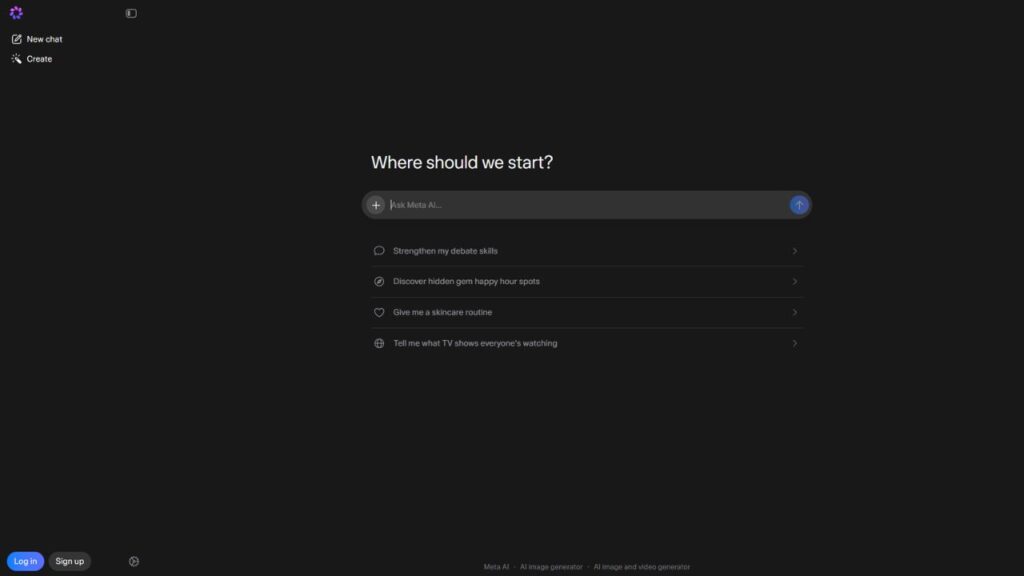
 ChatGPT
 Perplexity
 Claude AI

 Official Website
 Meta AI : Is the Free AI Assistant Actually Good Enough?
You already have Meta AI on your phone. It’s sitting inside WhatsApp, Instagram, Facebook, and Messenger — apps you probably open ten times a day. The question isn’t whether you have access to Meta AI. The question is: should you actually use it?
After spending time with the tool across multiple platforms, here’s an honest breakdown of what works, what doesn’t, and who this assistant is genuinely built for.
Quick Facts
| Detail | Info |
|---|---|
| Developer | Meta Platforms, Inc. |
| Founded | 2023 (public launch) |
| Category | AI Chatbot / Virtual Assistant |
| Underlying Model | Llama 4 (Maverick & Scout) |
| Free Plan | Yes |
| Starting Price | $0 (paid tier in testing) |
| Best For | Casual users, social media creators, WhatsApp power users |
| Platforms | Web, iOS, Android, Facebook, Instagram, WhatsApp, Messenger |
| gyanshout.com Rating | 4.1 / 5 |
What Is Meta AI? (And Who Actually Needs It)
Meta AI is Meta’s conversational AI assistant, built on the company’s own Llama 4 large language model. It lives natively inside Facebook, Instagram, WhatsApp, and Messenger — which means billions of people already have it without downloading anything new.
In April 2025, Meta also launched a dedicated standalone app focused on voice-first interaction. That’s a shift. Most AI tools are still primarily text-based. Meta is betting hard on voice as the future of how we interact with AI — and honestly, it’s a smart read of where things are going.
Who needs it? Primarily people who already live inside Meta’s app ecosystem. If you’re using WhatsApp to coordinate with your team or Instagram to grow an audience, Meta AI fits naturally into those workflows. You don’t have to switch apps or change habits — the assistant is just… there.
It’s less compelling if you need serious research capabilities, advanced coding help, or document analysis at a professional level. But for everyday tasks inside Meta platforms, it’s remarkably frictionless.
Key Features of Meta AI — What Makes It Stand Out
Llama 4 Multimodal Foundation
Meta AI runs on Llama 4, released in spring 2025. The flagship Maverick variant carries 17 billion active parameters with 128 experts and reportedly beats GPT-4o on several standard benchmarks. The Scout variant offers a massive 10 million token context window — that’s roughly 80 novels worth of data in a single session.
What this means practically: Meta AI can handle complex, multi-step conversations without losing track of earlier context. It also processes both text and image inputs natively, so you can send it a photo and ask questions about it.
Platform-Native Integration
This is the real differentiator. Meta AI integration inside WhatsApp means you can ask it for restaurant suggestions mid-conversation with a friend, get a packing list while planning a group trip, or draft a message — all without switching apps. No competitor touches this level of integration for everyday users.
Instagram has it too. You can get caption ideas, hashtag research, and quick content help right inside the app where you’re already creating. It’s not always perfect — the caption suggestions can feel generic — but the convenience factor is hard to dismiss.
Real-Time Image Generation
Meta AI generates images directly inside your chats. Meta demonstrated real-time generation that updates live as you type your prompt — change a word, the image changes instantly. That’s faster than most dedicated image tools.
Quality is decent for casual use. If you need Midjourney-level photorealism or fine art control, look elsewhere. But for quick social media visuals or illustrating an idea, it works well and requires zero extra tools.
Voice Interaction (Standalone App)
The dedicated Meta AI app launched in 2025 is designed primarily around voice conversations. It supports multitasking — you can keep talking to the AI while doing other things on your device, with a visible microphone indicator showing when it’s active.
The voice quality has improved significantly with Llama 4 underneath it. Responses feel less robotic compared to earlier versions. This is Meta’s long-term play — they’ve been explicit that they believe AI will increasingly move to voice-first experiences.
Multilingual Support
Llama 4 was trained across 200 languages. For a global platform like WhatsApp — which is dominant in India, Brazil, Mexico, and much of Europe — this is critical. Users in non-English markets get real, usable AI assistance, not a stripped-down version.
Meta has already expanded AI characters to countries including India, Pakistan, Mexico, and several Latin American nations.
Web Search Integration
Meta AI can search the web in real time. This puts it ahead of any AI assistant limited to static training data. You can ask about today’s news, check current prices, or research a topic — and it pulls live results.
The quality of web-integrated answers is solid for general queries. It’s not a full replacement for a dedicated research tool, but for quick fact-checking and current event questions, it gets the job done.
Business and Enterprise Access
For companies, Meta AI for Business integrates into customer support channels, ad workflows, and data systems. Enterprise pricing runs around $30–34 per seat per month based on available information, which becomes significant at team scale. That’s roughly $300/month for a 10-person team — a real cost to factor in before committing.
Meta AI Pricing Plans — What You Actually Get for Your Money
Here’s the thing about Meta AI pricing in 2026: the free tier is genuinely good.
The free plan includes unlimited conversational queries inside all Meta apps, basic image generation, voice chat in the standalone app, web search, and multimodal inputs (text + images). For casual users, that covers nearly everything they’d need.
Meta has been testing a paid subscription tier. Reuters reported in early 2025 that a premium plan was in development, similar to ChatGPT Plus. As of this writing, no official paid consumer tier has publicly launched — though internal plans suggest it could arrive. When it does, expect pricing similar to competitors in the $20–30/month range.
For enterprise and business users, Meta AI access through Meta’s business platforms involves structured billing and higher usage limits. The per-seat cost around $30–34/month makes it competitive against Microsoft Copilot for Business and similar tools, assuming your team is already embedded in Meta’s ecosystem.
Bottom line on pricing: If you’re an individual user, you’re getting a genuinely capable AI assistant at zero cost. That’s a hard deal to beat. Business users need to do the math carefully given per-seat costs.
Pros and Cons of Meta AI
Pros:
- Completely free for individual users with no usage caps mentioned for core features
- Native integration across WhatsApp, Instagram, Facebook, and Messenger — no switching apps
- Built on Llama 4, which is genuinely competitive with leading models
- Real-time image generation built directly into chat interfaces
- Voice-first standalone app with solid conversational quality
- Web search integration keeps answers current
- Multilingual support across 200 languages
- No account creation needed if you already have a Meta account
Cons:
- Feature availability varies across platforms — what works on WhatsApp isn’t always available on Instagram
- Free plan includes sponsored suggestions in responses, which can feel intrusive
- Not ideal for power users who need advanced coding, deep document analysis, or complex research
- Enterprise pricing ($30–34/seat/month) adds up quickly for teams
- Privacy concerns remain for users wary of Meta’s data practices
- The standalone app is voice-focused, which isn’t everyone’s preference
- Caption and content suggestions can feel generic or templated
How Does Meta AI Compare to Alternatives?
| Tool | Best For | Starting Price | Free Plan | Overall Rating |
|---|---|---|---|---|
| Meta AI | Social media users, WhatsApp users | $0 | Yes | 4.1/5 |
| ChatGPT (OpenAI) | General AI tasks, coding, writing | $20/month (Plus) | Yes (limited) | 4.5/5 |
| Google Gemini | Google ecosystem users | $19.99/month (Advanced) | Yes | 4.2/5 |
| Microsoft Copilot | Microsoft 365 users, office workflows | $20/month (Pro) | Yes (basic) | 4.0/5 |
| Claude (Anthropic) | Writing, analysis, nuanced reasoning | $20/month (Pro) | Yes (limited) | 4.4/5 |
Meta AI’s strongest advantage is its distribution. No other AI assistant sits inside apps that billions of people use daily. For sheer accessibility, it wins outright. For depth and capability, tools like ChatGPT and Claude still have the edge on complex tasks.
Real-World Use Cases — Who Gets the Most Value?
WhatsApp Group Coordinators
Planning a trip with friends over WhatsApp? Meta AI can jump into the group chat to suggest restaurants, calculate splitting costs, build itineraries, and draft messages — all without anyone leaving the conversation. This is a genuinely useful integration that other tools can’t replicate. The friction elimination here is real.
Instagram Content Creators
Creators who post regularly can use Meta AI inside Instagram to brainstorm captions, research hashtags, and get quick feedback on content ideas. It won’t replace a dedicated content strategy tool, but for small creators who can’t afford a full social media stack, it covers the basics in a convenient spot.
Multilingual Business Owners
For a small business owner running WhatsApp customer service across multiple markets — think a boutique in Mexico City handling inquiries in Spanish and English — Meta AI’s multilingual support and WhatsApp integration is a practical fit. Automated responses, quick translations, and customer query handling all happen inside an app they already use.
Students Doing Quick Research
The web search integration makes Meta AI a solid homework companion. Students can get current information, ask follow-up questions, and get explanations of complex topics — all in a conversational format. The free access makes it an obvious choice for anyone on a student budget.
Developers Building on Llama 4
For teams building AI-powered products, Meta’s open model ecosystem via Llama 4 offers something genuinely valuable: the ability to self-host, fine-tune, and customize without depending on a closed API. Meta has been explicit about wanting Llama to become the industry standard for building on AI — and the combination of Scout and Maverick variants gives developers real options.
Have you tried Meta AI inside your WhatsApp chats yet? What’s your experience been with it for daily tasks?
My Honest Verdict — Should You Use Meta AI?
Score: 4.1 / 5
Meta AI is the most accessible AI assistant on the planet. It’s free, it’s already installed on your phone inside apps you use every day, and the underlying technology — Llama 4 — is genuinely competitive with the top models in the industry.
For casual users, social media creators, WhatsApp-heavy communicators, and people in global markets where English isn’t the primary language, Meta AI is an easy recommendation. The price is right (free), the convenience is real, and the voice capabilities on the standalone app are a legitimate step forward.
Where it falls short is depth. If your workflow demands advanced coding assistance, nuanced long-form writing, sophisticated document analysis, or complex research chains, tools like ChatGPT Plus or Claude Pro are more capable and worth the monthly cost.
The one thing to keep in mind: Meta’s business model involves advertising, and sponsored suggestions appearing in AI responses is a tradeoff that some users will find acceptable and others won’t. That’s a values call, not just a feature comparison.
Who should use it: Casual users, social media creators, WhatsApp power users, multilingual communicators, budget-conscious individuals who want AI without a subscription fee.
Who should look elsewhere: Power users needing deep research, developers wanting a closed-ecosystem API, enterprise teams doing the cost-per-seat math carefully.
What to do next: Open WhatsApp or Instagram and try the Meta AI assistant on a real task today — no sign-up required, no credit card, no friction. See how it fits your workflow before evaluating paid alternatives.
Meta Ai FAQ
Q : Is Meta AI free to use?
Ans : Yes. As of 2026, Meta AI is free for individual users across all Meta platforms — WhatsApp, Instagram, Facebook, Messenger, and the standalone app. There are no advertised usage caps for core features. A paid tier is reportedly in development but hasn’t launched publicly.
Q : Is Meta AI safe to use?
Ans : Meta AI uses the same account infrastructure as your existing Meta accounts. It’s as safe as using Facebook or WhatsApp. The main consideration is Meta’s data practices — the company uses interaction data in line with its privacy policy, which some users are cautious about.
Q : What is Meta AI best for?
Ans : Meta AI works best for everyday conversational tasks inside Meta’s apps: planning, quick answers, image generation, content ideas for social media, and voice-based assistance. It’s particularly strong for WhatsApp users who want AI without switching apps.
Q : Meta AI vs ChatGPT — which is better?
Ans : ChatGPT is more capable for complex tasks like coding, long-form writing, and in-depth research. Meta AI wins on accessibility and integration — it’s free and already inside apps billions of people use. For serious professional use, ChatGPT or Claude have the edge. For everyday convenience, Meta AI is hard to beat.
Q : What model does Meta AI use?
Ans : Meta AI runs on Llama 4, specifically the Maverick and Scout variants released in spring 2025. Llama 4 Maverick handles complex tasks with 128 experts, while Scout offers a 10-million token context window for extended conversations.
Q : Can Meta AI generate images?
Ans : Yes. Meta AI includes real-time image generation built directly into WhatsApp and other Meta platforms. You can generate and animate images within chats. Quality is solid for casual use, though dedicated tools like Midjourney offer more creative control.
Q : Will Meta AI get a paid subscription?
Ans : Meta has been testing a paid subscription plan. No official pricing or launch date has been confirmed publicly as of mid-2026. When it launches, expect a similar price point to competitors like ChatGPT Plus ($20/month).